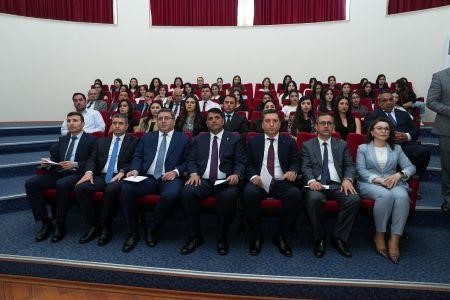
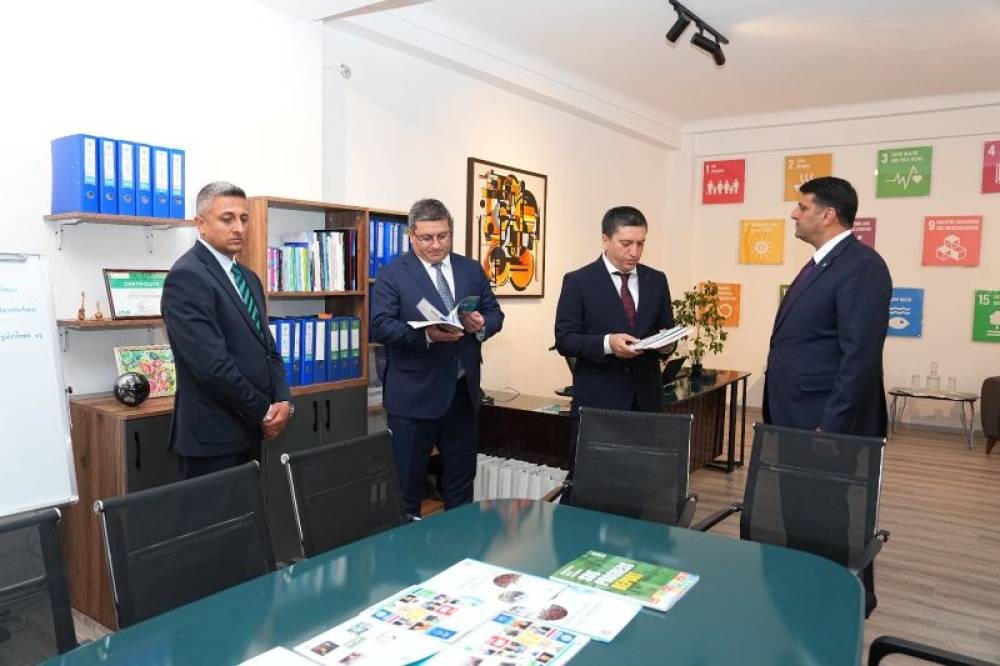
An awareness event was organized at Nakhchivan State University (NSU) to promote the local implementation of the Sustainable Development Goals (SDGs), identify priorities, and increase awareness of the 2030 Agenda. Prior to the event, participants visited an exhibition dedicated to the Sustainable Development Goals organized at the university. They were then introduced to NSU’s Sustainable Development Center. During the presentation of the Sustainable Development Center, Rajab Jafarli, Advisor to the Rector for Strategic Affairs, noted that the university operates both a Sustainable Development Center and a Sustainable and Strategic Development Department. In line with the university’s Sustainable Development Action Plan, key objectives and targets have been identified. To enhance awareness of the SDGs among academic staff and students, regular surveys, seminars, and training sessions are organized. It was noted that a series of training sessions covering the Sustainable Development Goals (SDGs) had been organized within the framework of international training programs with the participation of 21 international researchers from six countries. A total of 1,960 participants attended these training sessions. Participants were informed that NSU researchers have published more than 300 SDG-related articles indexed in the Scopus database. Over the past five years, Nakhchivan State University has produced the highest number of scientific publications related to the Sustainable Development Goals in Azerbaijan. The university’s achievements in international rankings were also highlighted. NSU has been ranked within the 401–600 and 601–800 bands across various categories of the Times Higher Education Impact Rankings. In addition, the university holds 628th place among 1,700 universities worldwide in the UI GreenMetric World University Rankings. It was emphasized that the involvement of 57 international professors at NSU’s Sustainable Development Center has made a significant contribution to strengthening the university’s international academic environment, expanding SDG-related research, and enabling students to benefit from international experience. Opening the event, Rector of Nakhchivan State University Elbrus Isayev paid tribute to the memory of National Leader Heydar Aliyev and stated that NSU was established with the support of the Great Leader. He noted that the transfer of two research institutes under the administration of NSU by a decree of President Ilham Aliyev is a clear example of the strong support provided to higher education institutions. The Rector stated that NSU currently provides education and training in 250 specializations at undergraduate, master's, and residency levels. He also noted that the university comprises three colleges, two schools, and two research institutes. Referring to the university’s internationalization policy, Rector Isayev highlighted the importance of the International Examination and Training Center, the SAT Center, and cooperation with IBM in advancing the implementation of the Sustainable Development Goals. The Rector emphasized that the Sustainable Development Goals (SDGs) are among the priority areas in education, as they are across all sectors. He noted that ensuring the alignment of the university’s activities and research with the SDGs is a key requirement of the institution’s Strategic Development Plan. He also stated that the university’s SDG Club, which has more than 700 registered members, operates according to a systematic and well-defined action plan and has successfully implemented 20 projects to date. Speaking at the event, Kazim Huseynaliyev, Minister of Economy of the Nakhchivan Autonomous Republic, stated that Azerbaijan is among the leading countries that consistently and transparently present their achievements in sustainable development at the international level. He emphasized that the Nakhchivan Autonomous Republic, with its strategic geographical location and human capital, plays an important role in this sustainable development process. The Minister noted that the region’s potential in agriculture, industry, logistics, tourism, and other sectors has been aligned with the SDGs. He also highlighted the economic progress achieved in the Nakhchivan Autonomous Republic in recent years and the measures undertaken to implement the Sustainable Development Goals, stressing that these accomplishments are the direct result of the long-term and consistent socio-economic policies pursued by President Ilham Aliyev. Huseyn Huseynov, Advisor to the Minister of Economy of the Republic of Azerbaijan, stated that the cities of Shusha and Nakhchivan had been selected for the Joint SDG Localization Initiative. He noted that the United Nations and its partners continue to support Azerbaijan’s efforts to achieve the Sustainable Development Goals. Through this partnership, Azerbaijan has prioritized all 17 SDGs, 88 targets, and 119 indicators covering the economic, social, and environmental dimensions of sustainable development. The importance of the Sustainable Development Goals for the socio-economic development of regions was emphasized. It was noted that localizing global goals enables regions to better assess their potential, use available resources more efficiently, and establish sustainable development models. Mr. Huseynov highlighted that regional development depends not only on economic indicators but also on education, science, innovation, environmental sustainability, and social welfare. In this regard, he stressed the importance of higher education institutions actively contributing to regional development strategies. Universities, through scientific research, innovative projects, and the training of qualified professionals, make a significant contribution to regional development. He also commended Nakhchivan State University for implementing activities aligned with each of the Sustainable Development Goals, describing this approach as one of the most important aspects of effective SDG implementation. The event continued with presentations by Mulayim Akhundova, Deputy Head of the Department for Cooperation with International Organizations at the Ministry of Economy, on “The Purpose, Principles and Benefits of SDG Localization: A Summary of International Experience,” and by Fariz Ahmadov, Deputy Head of the Department for Regional Development, on “Regional Socio-Economic Development.” Following the presentations, participants’ questions were answered and extensive discussions were held on the topics addressed. The event concluded with a commemorative group photograph.